History Has Its Eyes On You
They will see We the People are strong
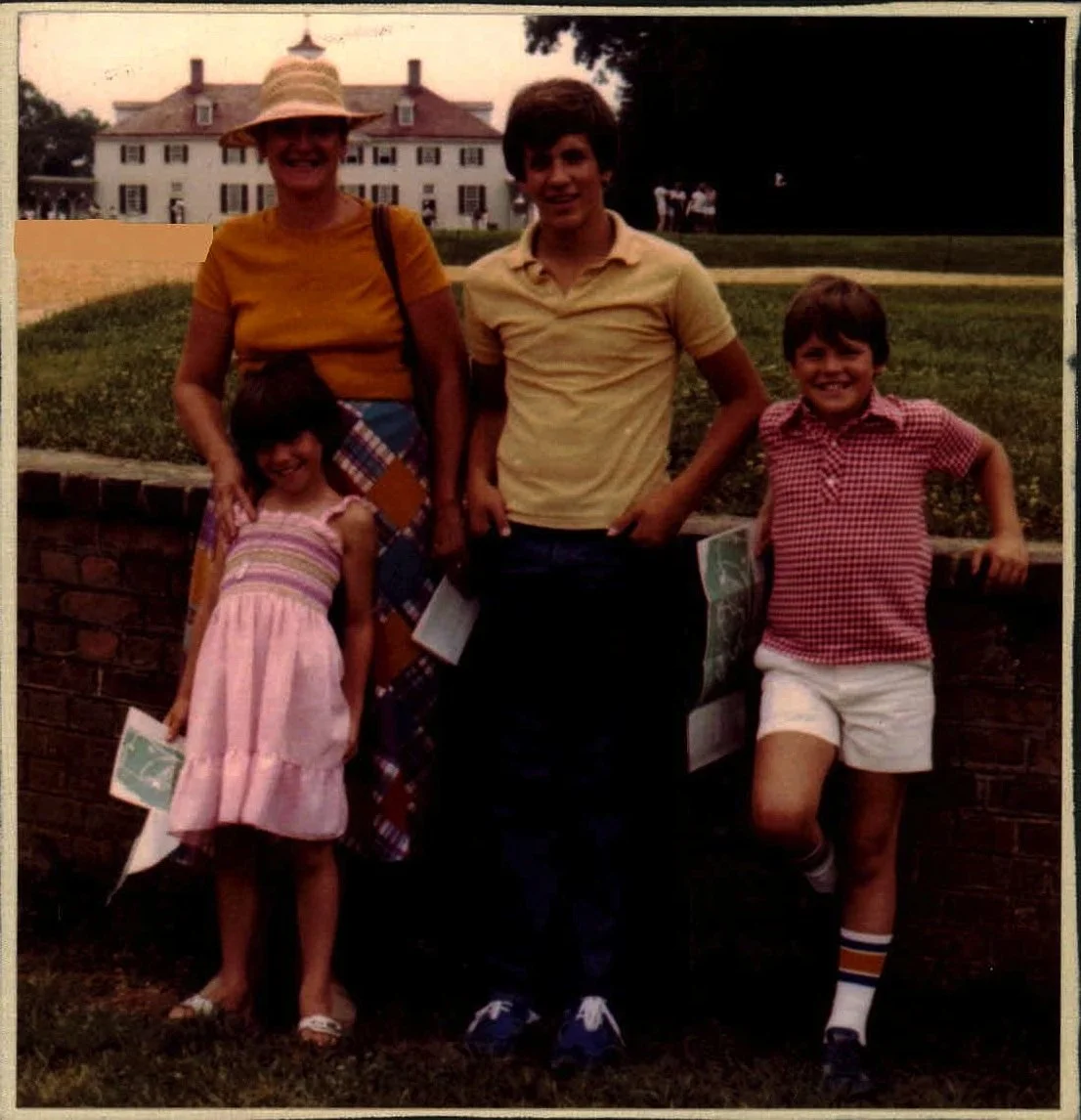
Visiting Mount Vernon in 1979 with my mom, younger brother and sister.
(Listen To The Essay)
I was baptized in my backyard swimming pool into the Lin-Manuel Miranda Church of Hamilton. It was the mind numbing, Covid lockdown summer of 2020. Disney had just released a recording of the Broadway stage production. My wife, Heidi, and I hung a bed sheet on a clothesline and hosted our own dive-in showing.
I had seen the play at the Richard Rodgers Theater within the first year of its debut but had not caught the fever at that time. My wife and all our young-adult children had the fever. Family car trips were sure to trigger a spontaneous breakout of Hamilton carpool karaoke. By the time we hosted the dive-in, Heidi had seen Hamilton a half dozen times – most recently in Puerto Rico where the original cast reunited as part of a campaign to raise relief funds in the aftermath of Hurricane Maria. The Puerto Rico performance coincidently took place just days before the Covid shutdown.
I must confess to harboring a bit of overzealous enthusiasm for all things patriotic. Some might also consider me a little over the top when it comes to affection for Broadway musicals. I don’t know if that’s a strange combination of passions or not, but I’ve been all in on both for as long as I can remember. I went to West Point for my college education and every weekend I could get off from the Academy, I spent in New York City with Heidi – my girlfriend at the time attending Parsons School of Design – where we’d stand in line at twofers to get tickets for whatever musical had seats available.
I never learned any nursery rhymes to sing to our children when they were little. I either sang marching cadences or Broadway show tunes. My kids will tell you it was not unusual to hear me sing:
Around her neck, she wore a yellow ribbon.
She wore in the springtime, in the marry month of May,
And if you asked her why the heck she wore it,
she wore it for that soldier who was far, far away.
For an encore, I might channel my best South Pacific, Emile de Becque French accented, baritone voice and sing:
Some enchanted evening
You may see a stranger,
You may see a stranger
Across a crowded room
And somehow you know,
You know even then,
That somewhere you’ll see her again and again.
The difference between my dive-in experience and my original conventional viewing at the Richard Rodgers Theater was subtitles. I don’t know how we thought to turn them on. It was probably an accident, and we just didn’t know how to turn them off.
Not too long after watching Hamilton while floating on an air mattress, I was fitted with hearing aids. My years as an artillery officer had taken their toll. Heidi insists I should have accepted the need for hearing aids a decade earlier. She was right, of course. My ears were just not up to the task when I saw Hamilton the first time. The speed of the hip hop rhythm and meter overwhelmed what was left of my post artillery hearing capacity.
Reading the Hamilton subtitles and, for the first time, really absorbing the rich, multilayered, We the People theme of Lin-Manuel Miranda’s masterpiece transformed my very connection to the American Continuum. My perception of American History, the American Dream, the Constitution, the American People and America’s untapped potential, was forever altered. Subtitles enhanced the opportunity for Hamilton’s brilliant poetry, music and dance to convey an elevated appreciation for the American Experience that emphasizes the quintessential element of humanity that quilts all that is America into that American Experience.
Humanity, in the end, is a team sport. We all win together, or we all lose. There is no reaching down to help the disadvantaged. There is only reaching out to share the privilege of freedom with absolutely everyone else – rich or poor, man or women, straight or not, black, white or brown. Sharing the privilege of freedom perpetually improves the collective opportunity for more freedom enjoyed by more people. To otherwise exclude anyone from the privilege of freedom has and will inevitably incite an attack from the excluded on those attempting to protect their own freedom at the expense of others.
The diversity of Hamilton’s cast where the race and ethnicity of the actors ignore the race and ethnicity of the portrayed characters is only the beginning of how the play emotes optimism for the ongoing evolution and continuous improvement of the virtue by which We the People perceive and deliver upon our contract to “secure the Blessings of Liberty to ourselves and our Posterity.” Miranda’s Hamilton does not just tell Hamilton’s story. It properly presents the democratic American ideals of equality, liberty and justice for all as living and breathing concepts that must be constantly nurtured, challenged and expanded. For example, Hamilton’s sister-in-law, Angelica Schulyer sings, "When I meet Thomas Jefferson, I'mma compel him to include women in the sequel!" America was born with room for improvement and will never outgrow the opportunity for more improvement.
In poetry, song and dance, Hamilton celebrates both America’s strengths and weaknesses maintaining joy throughout in the knowledge that we’re all only human, bound to err, and graced with the capacity for forgiveness. George Washington admits probable errors and Aaron Burr refers to himself as a “damn fool.” Alexander Hamilton’s lost battle with extramarital temptation, his wife, Eliza’s forgiveness and their shared mourning over the loss of their first born son does far more than just tell Hamilton’s story. It is an allegory for the very humanity that both impedes but ultimately propels forward the democratic American ideals of equality, liberty and justice for all. We the People must repeatedly suffer the limitations of our humanity, fall, pick ourselves up, forgive one another, and in the words of George Washington, “the nation learns to move on.”
Heidi had to swim over to the projector and pause the movie after Christopher Jackson, as George Washington, finished singing One Last Time. George Washington has decided not to run for a third term and, instead, retire to Mount Vernon to “sit under [his] own vine and fig tree, a moment alone in the shade.” The song, and Jackson’s moving delivery, got to me. I’m not sure if it’s the character, George Washington, who is crying or Jackson breaking the fourth wall of theater and crying himself, but when the song ended, I was crying right along with George Washington and/or Christopher Jackson.
One Last Time opened floodgates holding back a yet unexamined mass of various emotions surrounding years of personal and professional difficulties, and losses resulting from a confounding set of circumstances all tied to my patriotic zealousness. After I left the Army because my wife was not a fan of the lifestyle, I struggled with a loss of patriotic purpose for many years. Then one day, literally, the CIA knocked on my door. Years earlier, I had founded a technology firm that now had operations in Asia, South America and Africa. Between my West Point affiliation and the broad cover potential of my company, I was apparently an attractive candidate for CIA recruitment. I was ecstatic. Working with the CIA filled the whole in my heart left by my lost sense of purpose – a commitment to “Duty, Honor, Country” - when I exited the Army.
My time at the CIA ended badly. I received an award at a ceremony held at Langley for my work on a large project conducted under the cover of my company. Ironically, months later, the Security and Exchange Commission (SEC) inadvertently targeted that project in a financial fraud investigation that led to the demise of my company, personal bankruptcy and foreclosure on my family’s home. I lost all income and while being under an SEC investigation, my reputation made work prospects difficult. Heidi was not working outside the house at the time. Our five children ranged in age from 8 to 18 years old keeping her busy. We were facing a five alarm financial catastrophe giving me little time to grieve the confusing, disastrous crash of my patriotic intentions. I had to keep my shit together and figure out how to provide.
The pool we were floating in was located behind a house rented from an accommodating landlord willing to take a chance on a guy that could not come close to passing a credit check. Besides filing for bankruptcy, I had a million dollar IRS debt. The night of my baptism into the world of Lin-Manuel Miranda’s Church of Hamilton was nearly ten years after the onset of the SEC investigation. Our financial recovery was looking up. We had managed to purchase an old house which we were remodeling. We looked forward to moving into it after the renovations were complete. The financial recovery effort had been all encompassing. As such, I had spent little time unwinding the emotional impact from having the country I felt so loyal to – the country I believed I had faithfully served – turn on me. My service was met with criminal allegations. My family was hurt. No apology, no reconciliation, was ever offered. When Christopher Jackson as George Washington sang One Last Time, ten years of sadness, regret, loss, grief, anger, and confusion released all at once.
Please forgive any arrogance you might sense in me from the gravity of my thoughts in reaction to Washington’s song. In no way do I intend to compare myself to him. Nevertheless, and oh so humbly, I did identify with his melancholy reflection on a lifetime of service as his years increase bringing an inevitable end into focus: “The hope … that … after forty-five years of my life dedicated to its service with an upright zeal, the faults of incompetent abilities will be consigned to oblivion, as I myself must soon be to the mansions of rest.” While identifying with his sad reflection, the song still filled me with a renewed sense of hope and faith in the promise of American that I had not felt in a long time, and even forgiveness for where America had failed me.
Two specific lines captured me. First, when Hamilton sings, “Mr. President, they will say you’re weak,” and Washington responds in the plural form with “No, they will see we’re strong.” We – We the People – are strong. One Last Time reminded me that it is We the People that did “ordain and establish this Constitution for the United States of America.” The strength and hope for America is not held within the Office of the President, or Congress or the Supreme Court or the bureaucracy made up of countless agencies and departments. The strength and hope for America is held by We the People. I’ve lost confidence in the U.S. Government – a government that rejected my loyalty and hurt my family – but I have faith in We the People.
I have long believed that our elected officials reflect the population’s prevailing beliefs, sentiment and temperament. I did not vote for President Clinton, but I admired the idea that America had come to believe military experience was not a priority for presidential leadership. President Clinton was the first president since Herbert Hoover not to have served in the military. I did not vote for President Obama, but I celebrated America’s progress reflected in his election.
Recently, our elected officials have predominantly reflected the limitations of our humanity rather than the more admirable characteristics of our humanity. Beginning with the information technology economic revolution in the 1980s, a socially disrupting wealth divide has insidiously continued to grow inspiring, in response, the worst of humanity. Those on top of the economic scales are selfishly protecting what they feel they’ve earned and the rapidly growing number of people that find themselves on the bottom end of the economic scales are quick to lay blame and make accusations. We the People are currently electing representatives that reflect the most base aspects of our shared humanity.
The second line from the song One Last Time that captured me comes at the end of the song. Perhaps Christopher Jackson’s tears were meant to be expressed by his character, George Washington, but I don’t think so. I think they were pure Chrisopher Jackson tears. Just before he belts out, “Say Goodbye, One Last time,” for the big finish, he most definitely looks out directly at the audience, breaking the fourth wall of theater. He reaches out with his left hand to everyone watching him, sweeping it across the gathered crowd as if to say, “yes, I mean you,” and he sings, “history has its eyes on you.” I believe it is Christopher Jackson crying moved himself by the timeless virtue of the message he is delivering - History has its eyes on We the People and “they will see we’re strong.” Ten years of sadness, regret, loss, grief, anger, and confusion released from me all at once and in its place, I felt filled with a renewed sense of hope and faith in the promise of American, and forgiveness for where America has failed me. I believe in We the People.
My story of service is nowhere in the same orbit with Hamilton’s or Washington’s. My personal impact on the future of America is not important. I’m sharing my story because I doubt, I am the only American to experience sadness, regret, loss, grief, anger, and confusion as a result of feeling betrayed by a government that no longer reflects the spirit of a body ordained by We the People to “secure the Blessings of Liberty to ourselves and our Posterity.” It is my hope that my story inspires you to share your story and that your story inspires someone else to tell his story and his story inspires her story and so on until we all remember that We the People really do have more in common than anything that might divide us. If we can once again embrace our common interests, then Washington D.C. will follow – our elected representatives will be repopulated by individuals that reflect our consensus around having more in common. If We the People can repair our “more perfect Union” culturally, politicians attempting to divide us will fall out of favor and the spirit of a body ordained by We the People to “secure the Blessings of Liberty to ourselves and our Posterity” will likewise be repaired.
So, tell your story. Remember, “history has its eyes on you,” and “they will see we’re strong.”